His story
Four months old. Two strikes. One last chance.
Ryot got out. This is what that means, and why most don't.
01.
Before the pond.
There's a piece of how dogs are bought and sold that doesn't get talked about much. Somewhere between the rescues and the puppy mills, there are operations that breed dogs to sell and quietly dispose of the ones they can't move. Not all breeders. Not even most. But enough that this story keeps repeating itself across the country, in different breeds, in different counties, with different dogs and the same ending.
That's the world Ryot was born into.
The first family that took him home was an older couple. They loved the idea of a husky. They hadn't priced in what a four-month-old husky actually was: lungs like an alarm, legs like a sled team, hours of energy with nowhere to put it and not enough hours in a retired day to drain it. They returned him. They were honest about it. They knew they couldn't do right by him.
The second family was a young couple, fresh out of college and into a first apartment. A husky needs space. A husky needs attention. A husky needs time, and more of all of it than two people figuring out their own week could give. They returned him too.
By then Ryot was four months old and counting against himself. The breeder he'd come from didn't keep dogs that bounced back twice. The arithmetic was cold and the arithmetic was clear: dogs that couldn't be placed were a problem, and the cheapest way to solve a problem is to end it. That's not metaphor. That's how it works in those places. The clock starts the moment you can't sell, and it doesn't stop.
He was fourteen weeks past being the puppy anyone wanted, with two strikes against him, in a place where two strikes was usually the end of the count.
02.
The day I met him.
I didn't know any of this when I drove out there. I knew there was a four-month-old husky who'd been bounced twice and was about to run out of options. I knew enough to go.
The first time I saw Ryot, he ran across the field and jumped straight into my arms.
He had every reason to be cautious. He'd been packed up and re-packed three times in his short life. He didn't know me. He didn't know whether this was another temporary stop. None of that mattered to him in the moment. He came at full speed and made up his mind before I'd said a word.
That's the moment I fell in love with him.
Most rescue stories want a scene like that. They reach for it. This one was real. It happened the way I'm telling you it happened.
Everything after that was quieter. There was a drive home where neither of us said much. There was a first night in a new apartment where he slept against the door, because he didn't fully trust he'd still be there in the morning. The love was a single afternoon. The trust took the whole next year.
What changed wasn't dramatic. What changed was that the clock stopped.
03.
Living with him.
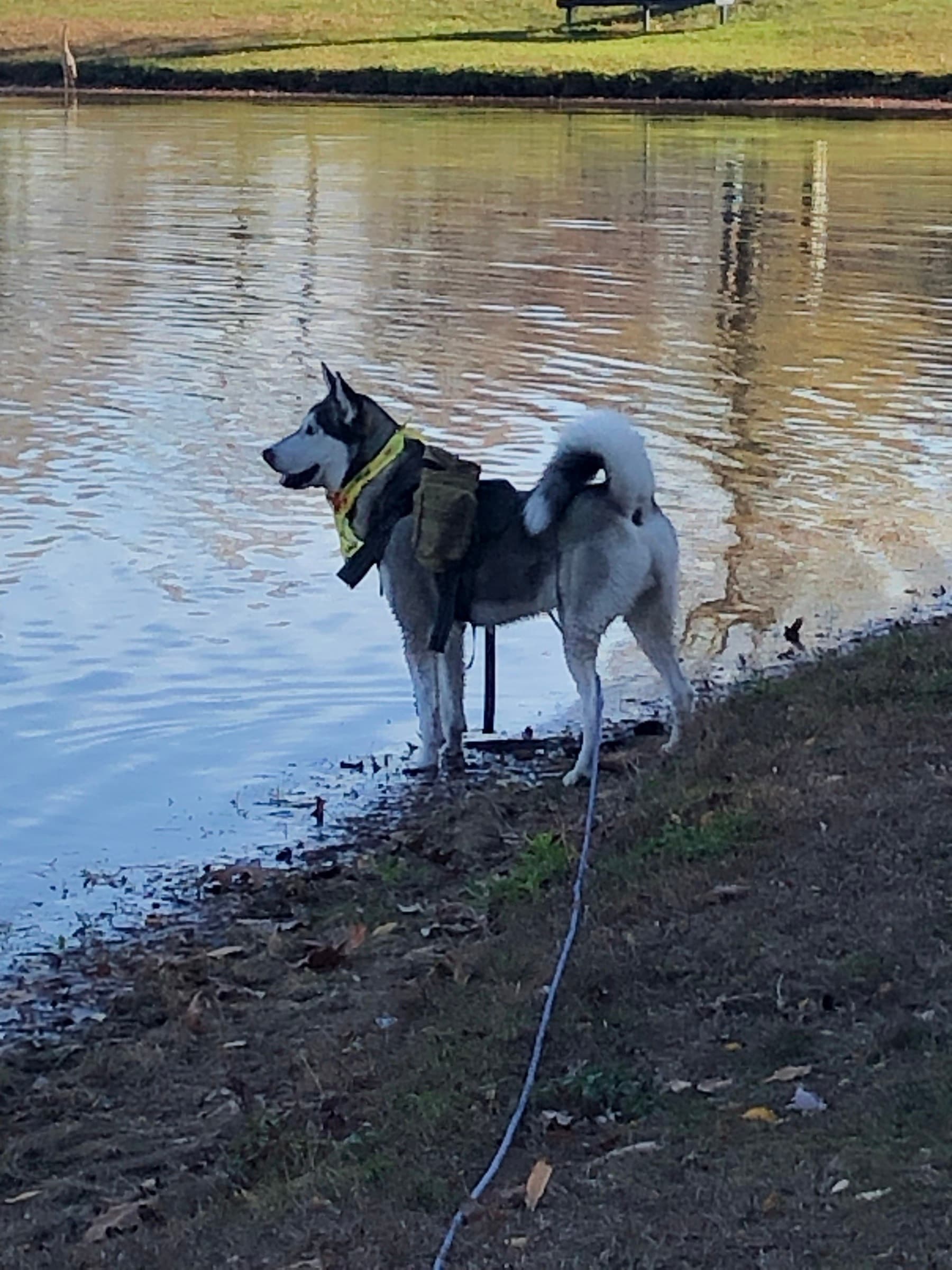
Ryot is four now. He turns five in November. He weighs 110 pounds.
That last fact matters, because most of the romance about rescuing a dog skips the part where the dog is large and athletic and absolutely does not understand that the lamp is not a chew toy. He pulls hard on a leash. He has the kind of physical confidence that comes with being a hundred and ten pounds of working-breed muscle that genuinely believes a closed door is a request, not a refusal.
The first year was expensive. By a rough count, he ate or destroyed something like ten thousand dollars of tech equipment. Cables, a couple of laptops, headphones, controllers, anything left within reach. He was four months old when I got him and a husky and bored and full of energy that had not yet been pointed at anything productive. I learned how to tire him out. He learned that some things are not for chewing. We met somewhere in the middle. That's where most of rescue actually happens. The first afternoon is dramatic. The first year is the slow process of two animals figuring out how to live in the same space.
I've been with him every day since the day I brought him home. That's not a sentence I write to be sentimental. It's a fact, and it is the part of his story that matters most.
The rescue moment is a single afternoon. The years after the rescue are the actual reason rescue exists. The whole point of pulling a dog out of an ending is that the dog gets to have everything that comes after. The walks. The naps. The way he watches me put my shoes on and decides whether the situation calls for participation. The fact that he'll hand you his paw without being asked, and the fact that he'll absolutely scream at the door if you take too long getting back.
He is, by any reasonable measure, a normal dog now. That is the entire victory.
He's my best friend.
I trust him more than anything in this world.
He fills my heart with love.
The miracle isn't the second chance. The miracle is the boring four years of a normal life that the second chance bought.
04.
The economy of disposable dogs.
This is where Ryot's story stops being about Ryot.
There are a lot of operations like the one Ryot came from. Some are licensed and some aren't. Some are open about how they run and some aren't. The thing they share is a business model where the value of a dog drops to zero, or below zero, the moment that dog can no longer be sold or rehomed. From there, the math is the math.
The pipeline that produces these situations is not exotic. People want puppies. Puppies are profitable. Adult dogs are not. When a litter doesn't all sell, when a dog gets returned, when an animal stops being marketable, what happens next depends entirely on the kind of person running the operation. Some make calls and find shelters and rescues and homes. Some don't. The ones that don't are the reason places like North Shore Animal League have to exist.
Most animals who end up in that situation don't have a Ryot ending. They don't have a stranger driving out to meet them on the day before the day. They don't have an internet-connected coin trying to redirect attention into rescue funding. They have a clock and they don't have anyone watching it.
That's the part that should make you angry, and it's the part that makes no-kill rescue worth fighting for. A no-kill rescue is an organization that has decided, structurally, that the clock doesn't get to win. They take in animals other shelters can't or won't. They hold them for as long as it takes. They don't run out of time on a dog the way the rest of the system can.
That's the alternative to what almost happened to Ryot. That's what your money is buying when 90% of these fees flow to North Shore Animal League.
05.
Why North Shore Animal League America.
North Shore Animal League Americahas been doing this work since 1944. They are, by any measure that matters, the largest no-kill animal rescue and adoption organization in the world. They are also part of the reason the words “no-kill rescue” carry the weight they carry now. They proved, at scale, that the model works.
They started by pulling animals out of one local kill shelter on Long Island. They still pull animals out of kill shelters now, but now they pull from across the country. They run mobile adoption fleets. They run transport networks. They fund medical cases other shelters can't afford. They take animals other organizations have already given up on.
If you have ever wondered whether one rescue can actually change the math at scale, NSAL is the proof of concept. They've placed over a million animals into homes across the eight decades they've been doing this.
If you live in a part of the country where animals routinely leave a shelter alive, NSAL is part of the reason. They built the playbook.
That's where the money is going.
06.
How $RYOT moves the math.
The coin part is, on purpose, the simplest section.
$RYOT is a memecoin on pump.fun. Every time it trades, the platform collects a small creator fee. 90% of those fees route directly to North Shore Animal League America. The remaining 10% covers the Solana transaction cost of every donation, plus paid boosts and DEX listings. That 10% is operational expense, not founder income. There is no salary. There is no profit margin. The split exists because the alternative is fewer donations reaching NSAL, not more.
A memecoin is, traditionally, a very stupid thing. The bet here is that the very stupid thing has a real audience and a real velocity, and that audience and velocity can be aimed at something that is the opposite of stupid. Attention turns into trades. Trades turn into fees. Fees turn into rescue funding.
It's not a clever financial product. It's a redirect. The point is what's at the end of it, not what it looks like in the middle.
If the coin moves, NSAL gets paid. If the coin sits still, NSAL gets nothing. That's the design.
Ryot got the chance. Most don't.
$RYOT exists so more do.
If you can buy a little, buy a little. If you can't, share this page or share the coin or just tell someone about North Shore Animal League. If you've never thought about what happens to a four-month-old dog with two strikes, now you have. That alone is worth something.
It's worth what happens next.